
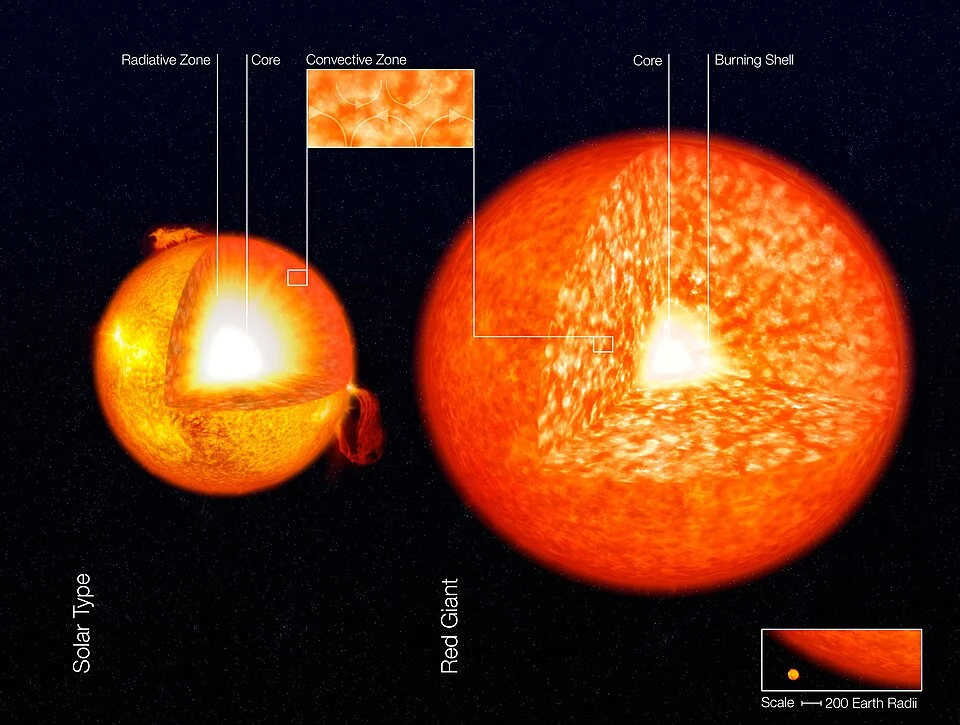
Stars are not the serene, unchanging beacons they appear to be. Over billions of years they swell, convulse, shed their outer layers and collapse into dense remnants. Throughout all of that drama, something appears to be surviving, something invisible, threaded through the stellar interior from the very beginning. A new study suggests that magnetic fields may in some way fossilise inside stars, persisting through every stage of evolution and eventually emerging at the surface of their ghostly remains.
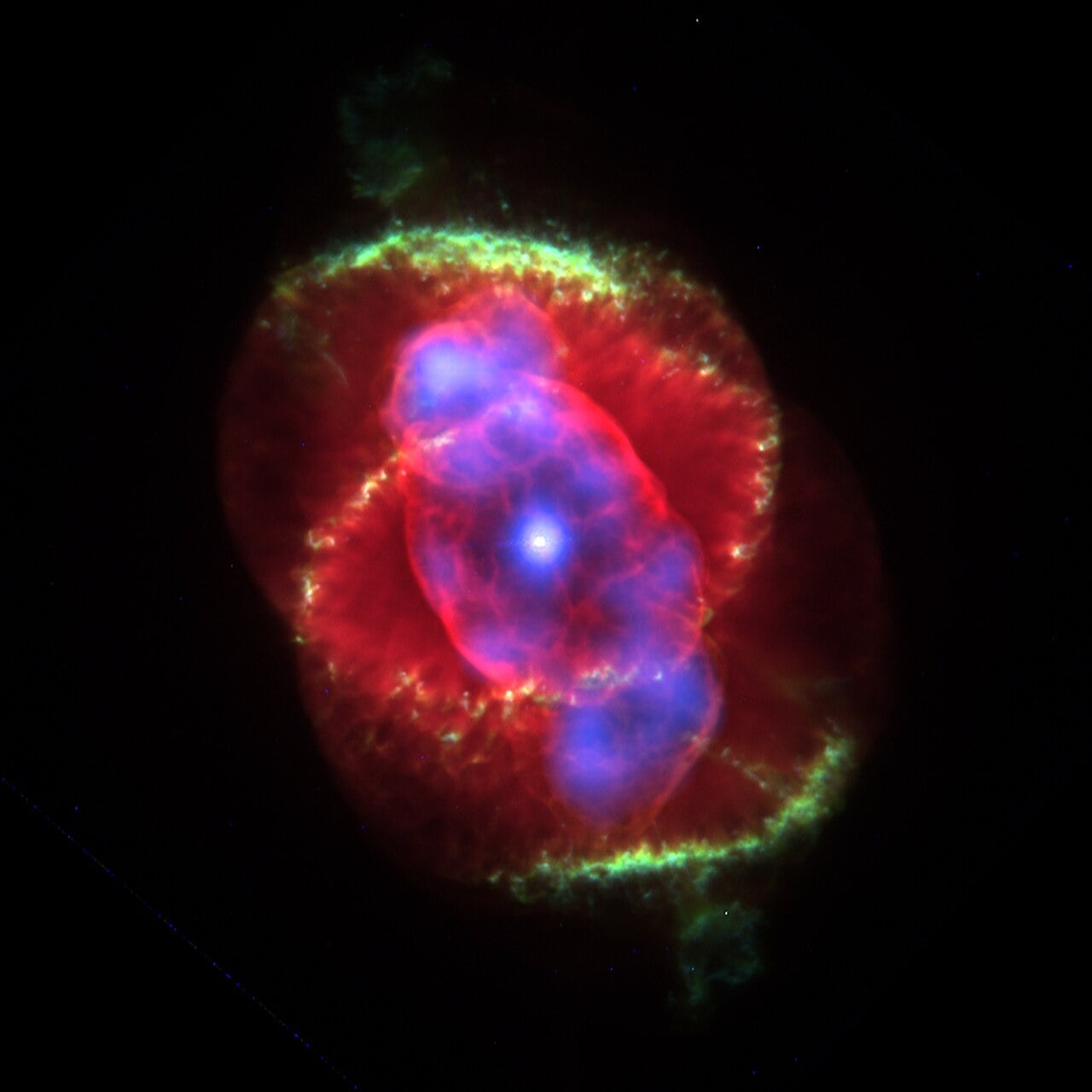 An X-Ray/optical composite of the planetary nebula known as the Cat’s Eye Nebula – NGC 6543 (Credit : J.P. Harrington and K.J. Borkowski)
The research, led by PhD student Lukas Einramhof and Assistant Professor Lisa Bugnet at the Institute of Science and Technology Austria, tackles one of the longer standing puzzles in stellar physics. Astronomers have observed magnetic fields at the surfaces of white dwarfs, the dense remnants left behind when stars like the Sun exhaust their fuel and collapse. They have also, more recently, detected magnetism deep inside red giants, the bloated dying stars that eventually become those white dwarfs. But nobody had connected the two observations. Were these the same fields, or different ones?
The answer required a new tool. Asteroseismology or starquakes to use its other term, either way, both sound pretty cool. In recent years this new field has given astronomers an extraordinary way to probe stellar interiors. Just as earthquakes reveal the structure of our planet’s interior, the subtle oscillations rippling through a star’s surface carry information about what is happening deep inside. Using asteroseismic data from red giants alongside observations of magnetic white dwarfs, the team built theoretical models to test whether a single magnetic field could plausibly survive the entire journey from young star to cold remnant.
To summarise, their models say yes. The simulations show that magnetic fields born early in a star’s life, long before the red giant phase even begins but don’t concentrate at the core itself but instead form hollow shell like structures. Think of it less like a bar magnet and more like a magnetic bubble surrounding the core. These structures persist through the red giant phase, the shedding of the outer envelope, and the final collapse into a white dwarf. Billions of years later, as the remnant slowly cools, those ancient fields migrate outward and appear at the surface. Fossil magnetism, preserved across in time.
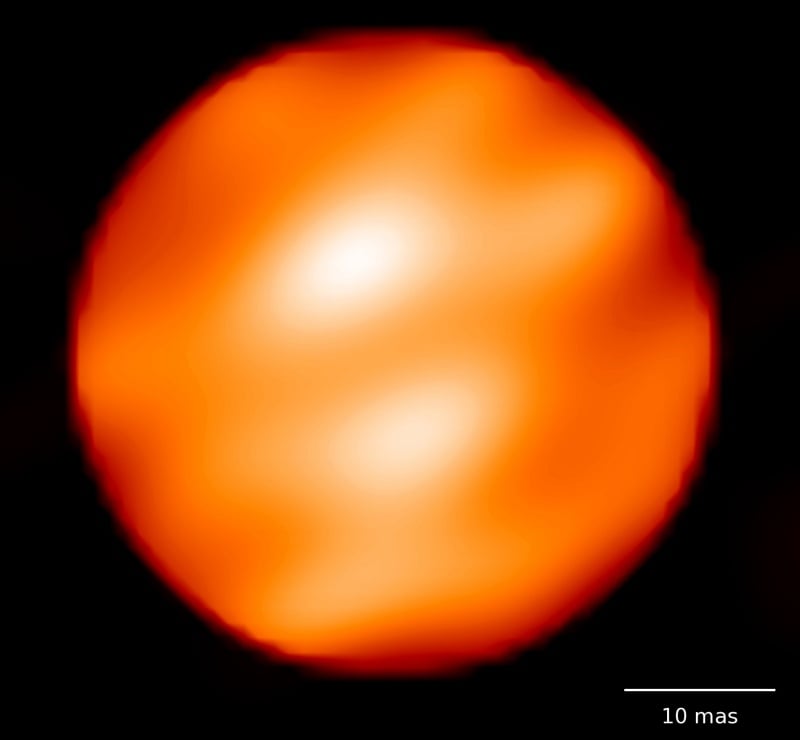 The surface of Betelgeuse captured using infra-red interferometry (Credit : NASA/ESO)
There is a catch, however since, for the fossil field theory to hold, the magnetism within the red giant’s core must already extend across a large fraction of its interior. Crucially, this doesn’t mean the field needs to be stronger, only that it must reach further through the core than previously assumed. The ISTA team notes that most stars are probably magnetic, but that detecting it remains difficult. What drives these fields in the first place, and exactly how strongly they influence stellar evolution, remain open problems and perhaps ones that future starquake observations can help to answer.
If magnetic fields genuinely survive a star’s entire lifetime as the study suggests, they could significantly affect how that star evolves, potentially mixing hydrogen from the outer layers into the core, extending its lifespan. Our own Sun will eventually become a red giant and then a white dwarf, and whether its internal magnetic field shapes that future is now a live question. As Einramhof puts it, even though the Sun is our own star, we remain practically blind to what is happening at its centre and if its core turns out to be magnetic, it would change everything the current models are built on.
Source : Starquakes and the Archaeology of Stellar Magnetism