Engineers love a good practical challenge, especially when it comes to spaceflight. But there’s one particular challenge facing the crewed missions of the near future that scares mission planners above almost all others – fire. For decades, we’ve relied on a NASA test known as NASA-STD-6001B to screen material flammability for flight. But space is much more complicated than an Earth-bound test provides for. A new paper from researchers at NASA’s Glenn Research Center and Johnson Space Center and Case Western Reserve University details a planned mission to test the flammability of materials on the Moon’s surface – where they expect flame to act much differently than it does here on Earth.
To understand the problem, it’s first helpful to understand the test. NASA-STD-6001B requires holding a six-inch flame to the bottom of a vertically mounted piece of material. If the material burns more than six inches up from the bottom, or drips burning debris, it fails the test. Sounds reasonable enough, but there’s a catch – the test is done on Earth.
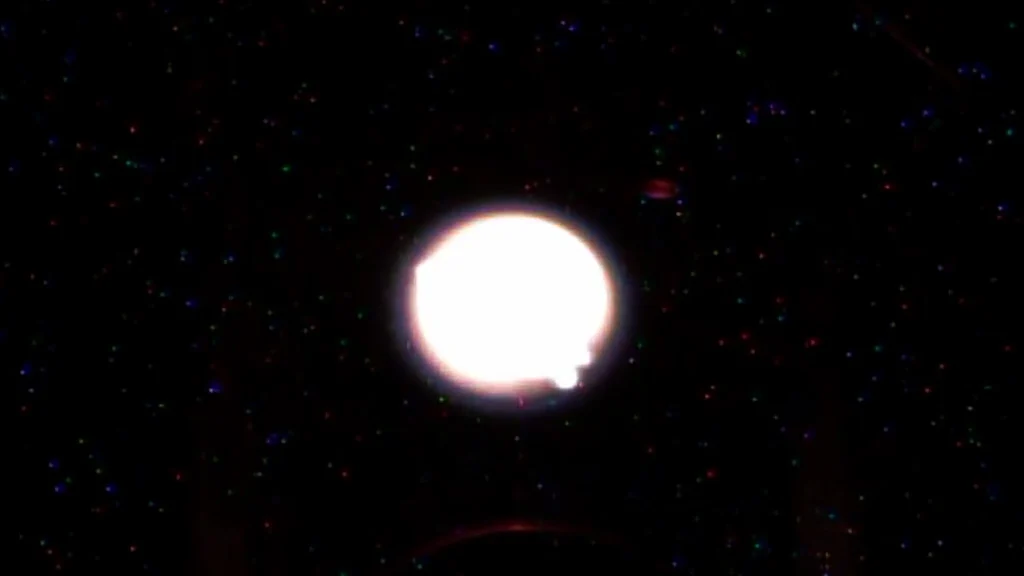
In Earth’s environment, there’s air that is moving around causing convective currents. There’s also an “up” and “down”, whereas in environments like the International Space Station, those orientations don’t exist. Consequently, fires don’t point “up” in microgravity – they form spherical blobs of flame that spread slowly outward, and they are almost entirely fed by the station’s ventilation systems.
Scott Manley talks about why fires in space are so dangerous. Credit – Scott Manley YouTube Channel
But simply turning off the ventilation system wouldn’t solve the problem. Sure, the lack of air movement might slow a fire down, but it would simply cause some material to smolder, waiting for the fans to turn back on so it can reignite. The best solution would be to test the physics of flames on the ISS itself – but that would open up the entire habitable space station to an open flame. That’s a situation researchers would rather avoid for obvious reasons – at least fires that are big enough to do damage to material (they lit 1,500 smaller ones to study how combustion works at one point).
Instead, NASA has previously turned to the Spacecraft Fire Safety (Saffire) test. These experiments were conducted inside an uncrewed Cygnus cargo capsule after they were detached from the ISS and before they tumbled into Earth’s atmosphere to burn up. During these tests, researchers ignited large sheets of cotton/fiberglass, fabric, and acrylic to watch how they burned in microgravity. They found some weird physics, with flames sometimes spreading in the opposite direction of the airflow and burning hotter on thinner materials.
Data from Saffire were enough to point out the discrepancies between the NASA standard and the realities of fire in space. So they turned to the next best option – drop testing. However, watching how flames react when released from a drop-tower (5 seconds of weightlessness) or even on a parabolic plane flight (25 seconds of weightlessness) isn’t enough to study what long-term damage they can do.
Video Describing the Saffire Research Project. Credit – NASA Glenn Research Center YouTube Channel
Enter Flammability of Materials on the Moon (FM2) experiment. The lower gravity on the Moon is actually an even more interesting place to study flame dynamics. On Earth, gravity causes hot gases to rise, drawing fresh, cool oxygen to the base of the flame. In some cases where the material is marginally flammable, this can result in a phenomenon called “blowoff” which actually extinguishes the fire. On the Moon, that flow exists, but is much slower, allowing oxygen to be continually resupplied to the flame without creating fast enough vapor movement to allow for a blowoff condition. In other words, materials that might not truly be flammable on Earth could burn for a very long time on the Moon.
Future lunar explorers do not want to have a raging fire in their habitat for obvious reasons, so it’s better for us to understand how to prevent them sooner rather than later, giving the upcoming deadline for when we will have a permanent crewed presence on the lunar surface. FM2 will contribute to that study by launching on a Commercial Lunar Payload Service (CLPS) mission to the Moon’s surface.
There, a self-contained chamber will burn four solid fuel samples in long-duration lunar gravity, which is impossible to recreate anywhere else as of now. The chamber will be equipped with cameras, radiometers, and oxygen sensors to monitor the flame and its atmosphere in real time. It will offer the first bridge between the theoretical flame behavior in partial gravity and the observed behavior in 1G and zero-gravity from previous studies. Crucially, there will be minutes of data compared to the seconds provided by drop tests and parabolic flights.
Whether or not NASA will update its standard remains to be seen – launching a self-contained capsule for flame testing to the Moon seems like it would be cost-prohibitive. But there’s no replacing real data from the real environment, and FM2 will, for the first time, provide some data on flame behavior from our next major outpost in the solar system. Scientists and sci-fi writers alike will be keeping a close eye on their results.
Learn More:
P. Ferkul et al. – MATERIAL FLAMMABILITY AT LUNAR AND MARTIAN GRAVITY
UT – The Most Dangerous Part of a Space Mission is Fire
UT – NASA is Done Setting Fires Inside its Doomed Cargo Spacecraft