
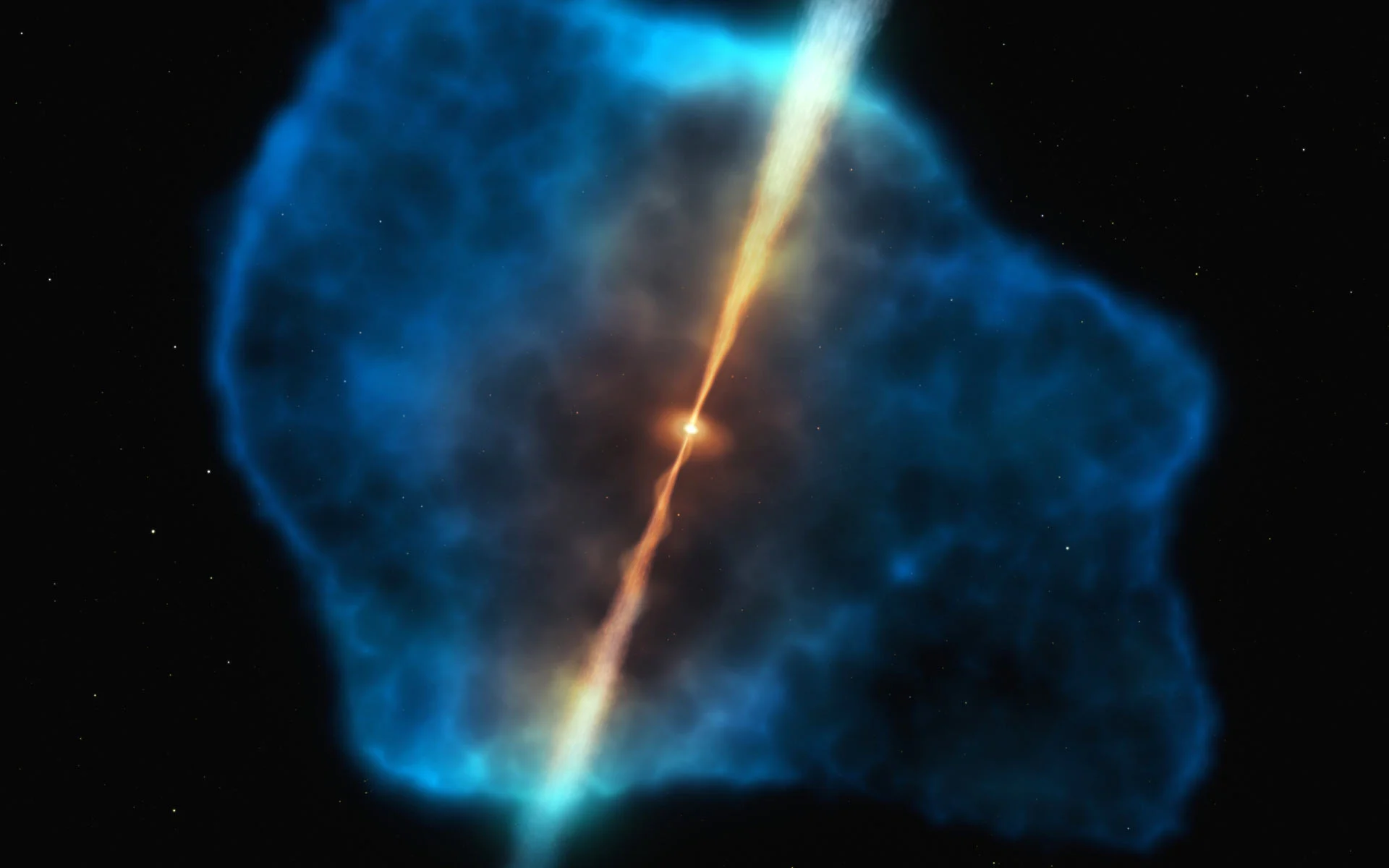
Based on the most widely accepted models of how the Universe began – Big Bang cosmology and the LCDM model – scientists theorize that massive clouds of neutral hydrogen permeated the Universe. From this material, the first stars and galaxies formed rapidly over the next several hundred eons, an event that astronomers and cosmologists refer to as “Cosmic Dawn.” For some time, it was further theorized that these early galaxies were surrounded by gigantic hydrogen gas halos, called “Lyman-alpha nebulae.”
In theory, these galaxies would have required vast reservoirs of hydrogen gas to form as rapidly as they did. Until recently, however, astronomers had found evidence for only a few thousand of these clouds. And now, a team of astronomers using data from the Hobby–Eberly Telescope Dark Energy Experiment (HETDEX) at The University of Texas at Austin McDonald Observatory has discovered tens of thousands of halos that existed 10 to 12 billion years ago – coinciding with “Cosmic Dawn.”
The study was led by Erin Mentuch Cooper, the HETDEX Data Manager, and Karl Gebhardt, the HETDEX Principal Investigator and the chair of UT Austin’s astronomy department. They were joined by researchers from the Institute for Gravitation and the Cosmos (IGC), the Kavli Institute for the Physics and Mathematics of the Universe (IPMU), the National Astronomical Observatory of Japan (NAOJ), the Leibniz-Institute for Astrophysics Potsdam (AIP), and multiple universities. The paper describing their findings recently appeared in The Astrophysical Journal.
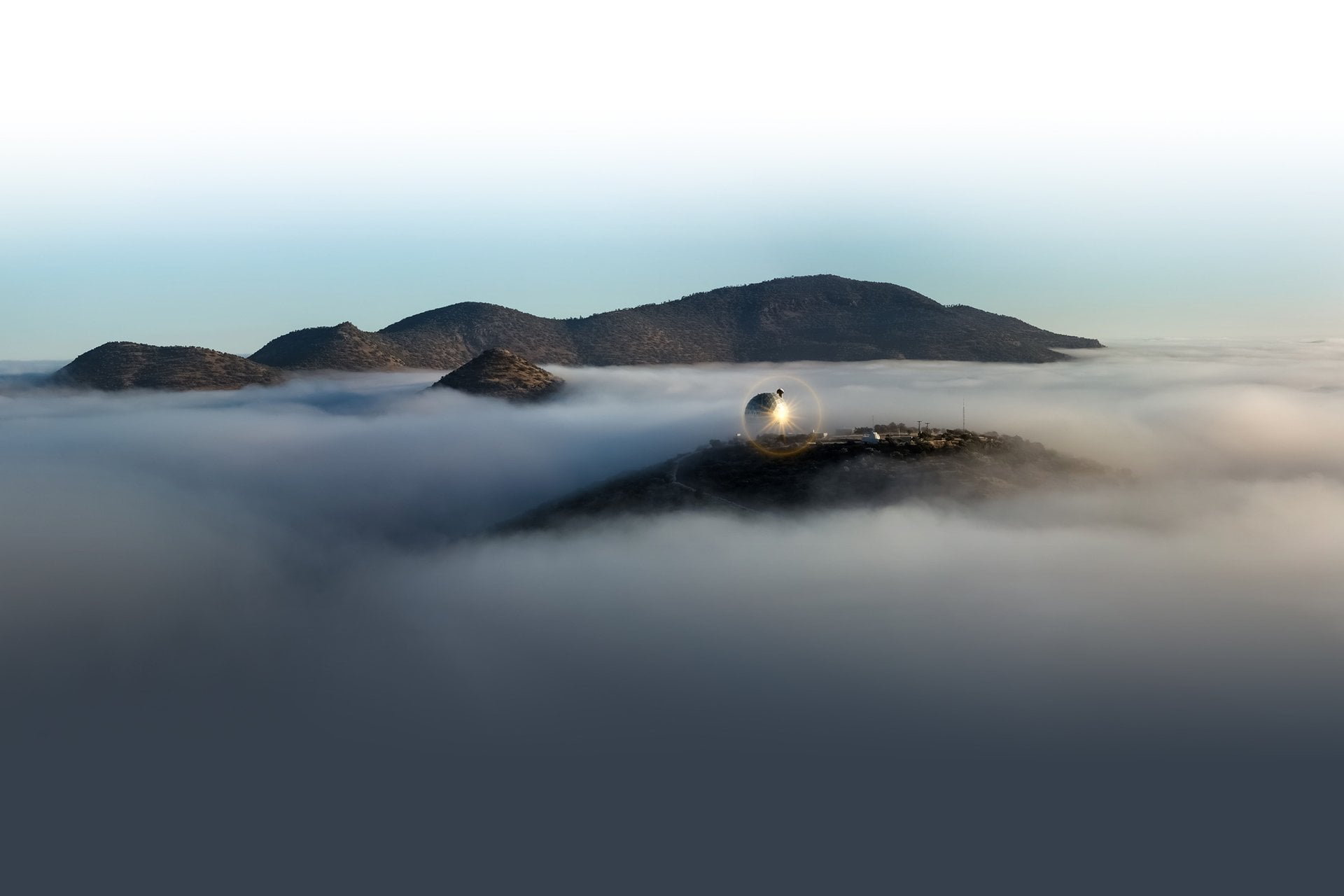 *The Hobby–Eberly Telescope Dark Energy Experiment (HETDEX) outside of Austin, Texas. Credit: HETDEX/UT Austin*
HETDEX was designed to map the positions of over one million galaxies during its three-year nominal mission to measure the influence of Dark Energy. By statistically combining the spectra of thousands of distant galaxies (a technique known as “stacking”), researchers can detect very faint spectral features that are otherwise undetectable in individual galaxies. While hydrogen gas is incredibly difficult to detect because it doesn’t generate its own light, it will glow in the presence of bright, UV-emitting galaxies and stars.
Detecting this glow requires a dedicated observatory with precise instruments that can monitor the same patch of sky. “The Hobby-Eberly Telescope is one of the largest in the world,” said postdoctoral fellow Dustin Davis, a HETDEX scientist and co-author on the study. “And the instrument HETDEX uses produces 100,000 spectra in each observation. So, we have huge amounts of data, and there are all kinds of neat, fun, weird things waiting for us to find.”
Previous surveys detected only a few thousand halos (about 3,000) because their instruments were not sensitive enough to detect anything but the brightest examples. What’s more, observations of early galaxies are so magnified to eliminate interference from numerous foreground objects, leaving only the smallest halos visible. Because of this, anything between tiny halos and the most extreme has remained elusive to astronomers.
“We’ve been analyzing the same handful of objects for the past 20 or so years,” said Cooper. “HETDEX is letting us find many more of these halos and measure their shapes and sizes. It has really allowed us to create an amazing statistical catalog.” Of the 1.6 million early galaxies identified by HETDEX so far, the team selected the 70,000 brightest, which were then analyzed by supercomputers at the Texas Advanced Computing Center (TACC) to look for signs of a surrounding halo.
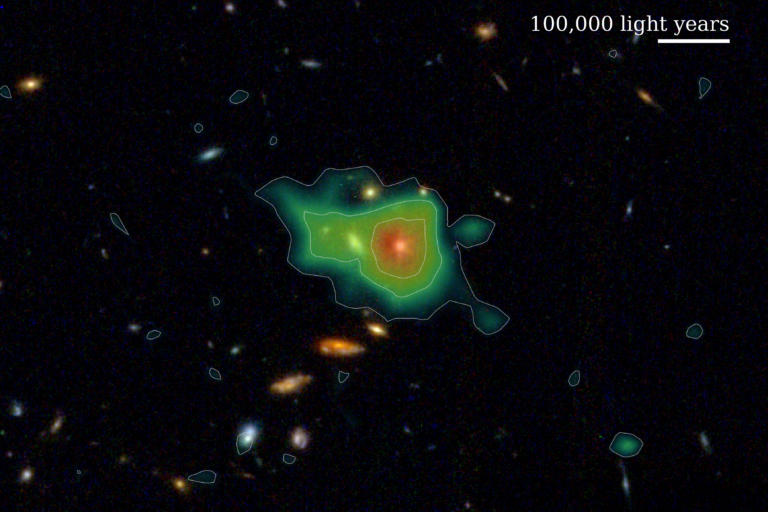 An enormous halo of hydrogen gas found in HETDEX data superimposed over its location as seen in deep imaging from the JWST. Credit: Erin Mentuch Cooper (HETDEX); NASA/ESA/CSA/STScI (JWST).
Nearly half of the candidates did, but Cooper and her team suspect the faintest systems aren’t bright enough to reveal how large they really are. In addition to increasing the number of known hydrogen gas halos by a factor of ten (~3,000 to 33,000), this research also increases the range of known sizes. The newly revealed halos measure tens of thousands to hundreds of thousands of light-years in diameter, enshrouding individual galaxies and galaxy clusters.
“We’ve captured nearly half a petabyte of data on not only these galaxies but the regions in between,” said Gebhardt. “Our observations cover a region of the sky measuring over 2,000 full Moons. The scope is enormous and unprecedented.” This not only confirms that these halos are not a rare phenomenon, but also provides a more representative sample for astronomers studying the early Universe. The team hopes their discovery will help scientists study how the early Universe evolved and conduct more detailed studies of the physics and mechanics governing hydrogen halos.
Further Reading: HETDEX