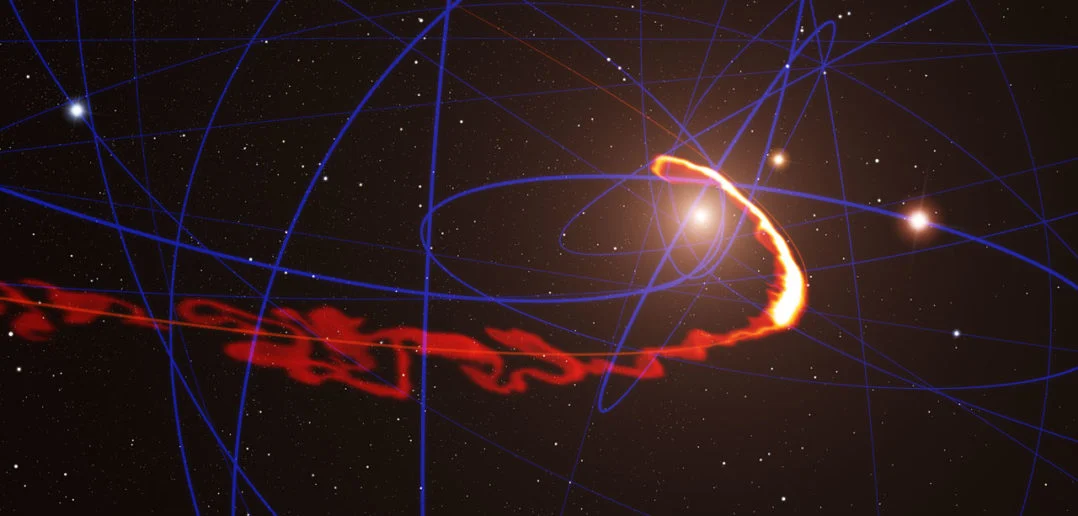
In 2014, a strange cloudy object called G2 made a close approach to Sagittarius A*, (Sag A*) the supermassive black hole at the heart of the Milky Way Galaxy. Astronomers were pretty excited, partly because they thought it might get torn apart by Sag A*’s intense gravitational pull. That didn’t happen, and the event turned out to be a cosmic fizzle. G2 skipped around the black hole, survived the flyby, and continued on a shortened orbit. Various observations showed that it wasn’t just a gas cloud. It was likely a dusty protostellar object encased in a dusty cloud. Or perhaps several merged stars.
If G2 had experienced a more direct encounter with Sag A*, astronomers might have captured a dazzling spectacle lighting up the galaxy as G2 got shredded and its material heated to produce a brilliant flare. Even though that didn’t happen, such flaring activity could explain how supermassive black holes (SMBH) embedded in galaxies can light up the dark, even though the black holes themselves emit no light.
New research by astronomers at Syracuse University and the University of Zurich (Switzerland), have produced computer simulations that explain how black hole-induced stellar destruction can result in flaring activity. The high-resolution computer models show that as a star is drawn into a death spiral around an SMBH, it gets ripped apart. The debris from that shredding eventually starts to “circle the drain” around the black hole in the accretion disk. Friction from debris collisions heats it up and it shines out, often brighter than the entire host galaxy. These collisions, called “tidal disruption events” (TDEs) do, in fact, light up galaxies. However, no two are exactly alike, and the team’s simulations attempt to explain why.
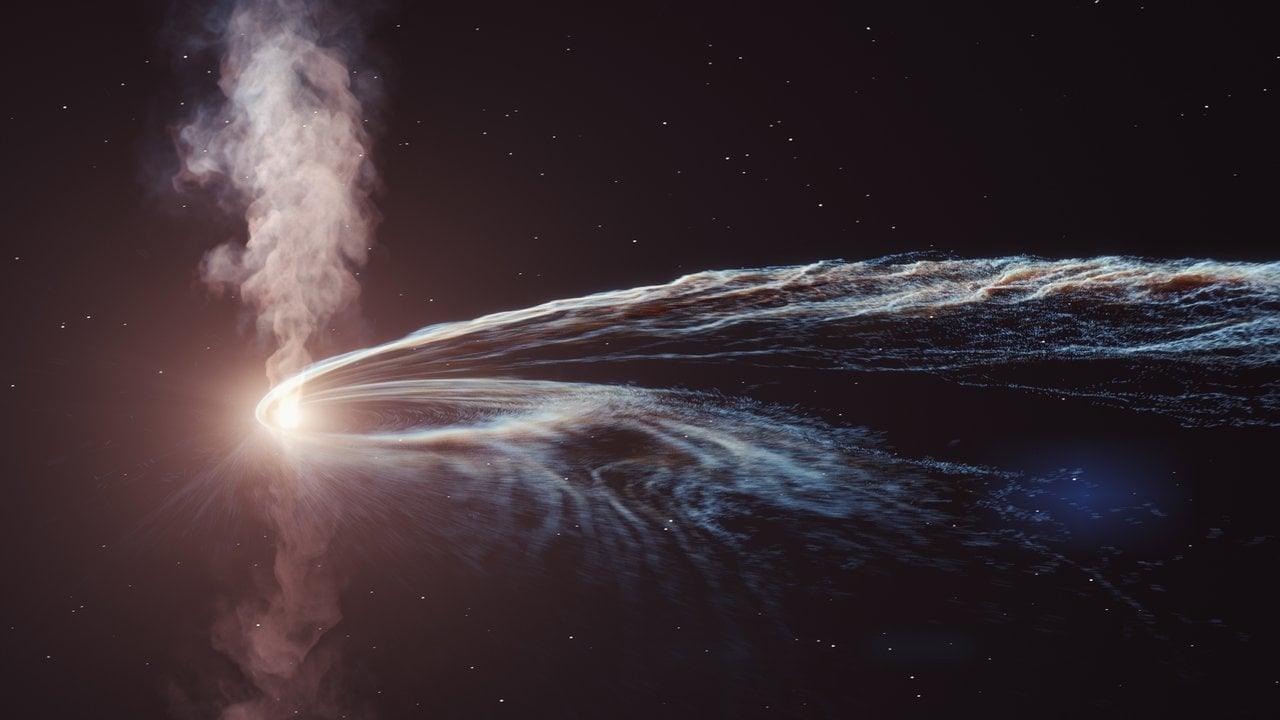 Artist’s depiction of a supermassive black hole tearing apart a star, with roughly half of the stellar debris flung back into space while the remainder forms a glowing accretion disk around the black hole. (Credit: DESY, Science Communication Lab)
Digging into TDEs
TDEs offer one of the few ways to study supermassive black holes in more depth, including Sagittarius A*, as well as those in in other galaxies, according to Eric Coughlin, assistant professor of physics at Syracuse. “We can study tidal disruption events to learn more about black holes hidden from view,” said Coughlin. That’s important, since many SMBHs are not always easy to observe. Our own Sag A* is behind clouds of gas and dust from our point of view. Astronomers have to observe it using X-ray, radio, and infrared telescopes. for example.
The action of a TDE is fascinating field of study because each event has its own characteristic fingerprint of activity. How it rises in brightness, when it peaks, and how long it takes to fade are all activities unique to each flare. To simulate them, the science team had to use a special method to simulate the conditions of the star and its interaction with the black hole. In addition, they needed to use characteristics of the black hole itself.
Their methodology known as smoothed particle hydrodynamics. It decomposes a star into “particles” that interact with one another hydrodynamically (i.e., according to the same fundamental equations that govern the flow of water through a pipe). The simulation used tens of billions of particles to model the disrupted star’s gas and shows what happens after a star gets ripped apart. Rather than dispersing chaotically, the debris forms a narrow, coherent stream that follows a predictable path around the black hole before crashing into itself. That crash of debris particles is what lights up the scene.
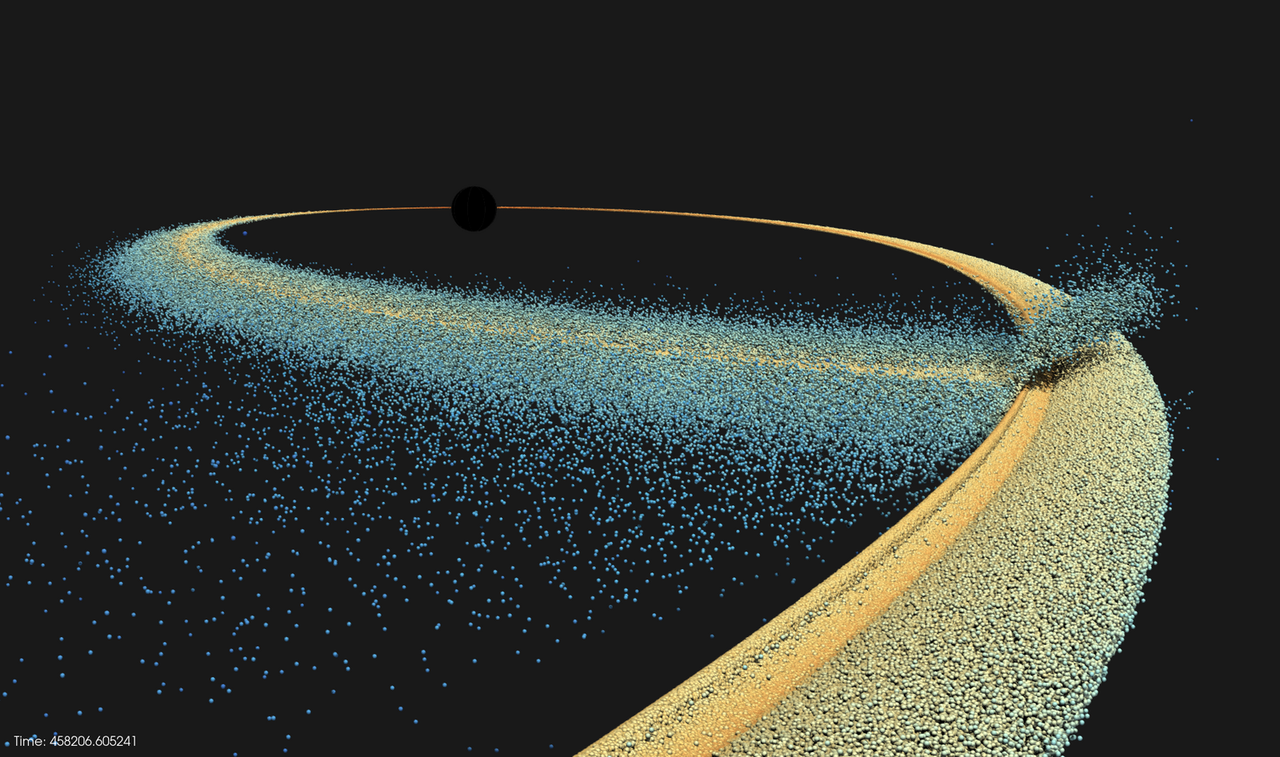 Three-dimensional rendering of modeled debris particles, highlighting the self-intersection of the debris stream flow described by a team of researchers including Syracuse physics professor Eric Coughlin. (Credit: Jean Favre, CSCS; Lucio Mayer and Noah Kubli, University of Zurich)
The Black Hole’s Contribution
The extreme gravitational pull of the SMBH is what rips the star apart in a TDE. But, there are other factors at work, too: the mass of the black hole, how fast it spins, and the orientation of its spin relative to the orbital plane of the stellar debris in the accretion disk. These influence when the flare begins, how bright it gets, and how long it lasts. So, if a black hole sucking down a star is rotating, that influences variations in the spacetime environment around it. It can produced something called “nodal precession.” Depending on how strong the precession is, the stellar debris stream could get shifted around and the resulting flare may or may not occur, or be very faint. In some cases, the flare may be delayed by several loops around the black hole.
That complication may help explain one of the enduring puzzles of TDE research. No two events look exactly alike. Some rise quickly and fade fast. Others unfold more slowly. Some are brighter, some dimmer. Some behave in ways that are quite difficult to explain. While differences in the mass of the black hole could account for some of these differences, these new simulations suggest that black hole spin may be one of the key reasons for that diversity.
Future observations of TDEs and SMBH regions with telescopes such as the Rubin Observatory, the Nancy Grace Roman observatory, and others should provide more tests of the team’s simulations. If so, that will help them better understand the characteristics of black holes in distant galaxies.
For More Information
How Black Holes Light Up the Dark
Tidal Disruption Events with SPH-EXA: Resolving the Return of the Stream