
(This is Part 3 of a series on Cherenkov radiation — the “light boom.” Read Part 1 and Part 2 first.)
We have our material — the crowd at the red carpet. We have our star particle — Brad Bradington. We have our paparazzi. Let’s watch what happens.
Brad steps out of his limo and walks at a nice, relaxed pace. The red carpet is absolutely packed — thousands of fans and photographers, crowding every inch. The people in the middle of the crowd and at the edges can’t see the limo from where they’re standing.
So when Brad appears, only the people right next to him know he’s arrived. And what do they do? They scream, they holler, they point their cameras and start snapping pictures. But only the ones nearest to him. The ones further back don’t even know he’s there yet.
As Brad walks slowly down the carpet, word of his presence spreads outward in all directions — a ripple of recognition, expanding like rings on a pond. If you had a bird’s-eye view, you’d see Brad moving through the crowd with these expanding rings of camera flashes around him, centered on wherever he happens to be.
Inside the material, this is a charged particle moving at a modest speed. It carries an electric field with it — a celebrity aura — and as it passes, it disturbs the atoms and molecules nearby. They stretch and squeeze and twist under the influence of that field, then snap back into place and release a tiny flash of light. These flashes radiate outward in all directions from wherever the particle is.
When the particle is moving slowly, the flashes from all directions are roughly in phase with each other. They overlap and interfere and largely cancel out. You don’t get a coherent glow. Nothing special happens.
But let’s say Brad Bradington is in a hurry.
Maybe he’s late. Maybe he hates crowds. Maybe he really has to pee. Whatever the reason — he leaps out of the limo and absolutely barrels for the entrance. Shoving people. Elbowing through. Zero regard for personal space.
The key: the paparazzi have a reaction time. Before they can snap a picture, they have to KNOW Brad is there. And the speed at which that knowledge travels — the speed at which the information “Brad Bradington is right here, right now” can reach a photographer’s eyes — is the speed of light in this material.
If Brad is moving slower than that speed, everything is orderly. He’s walking, light is running ahead of him, the paparazzi in front have plenty of warning, they fire from all directions, the flashes cancel out, no special glow.
But if Brad is moving FASTER than the local speed of light?
Then the paparazzi directly in front of him have no warning whatsoever. Zero. By the time any light from Brad reaches them, he’s already blown past. They only ever get a shot from behind, or from the side as he’s already gone.
Every single flash — the light released by every atom and molecule disturbed by Brad’s passage — is now entirely behind him. Instead of spreading out equally in all directions and canceling into nothing, they all pile up together. They reinforce each other. They add into a coherent wave, a shock front of light, spreading out behind the particle in a V-shaped cone.
It’s exactly like a sonic boom. When a jet aircraft exceeds the speed of sound, the sound waves it produces can no longer outrun it — they pile up into a pressure shock wave that you experience as a sudden violent crack. Cherenkov radiation is the same phenomenon, with light instead of sound. The particle drags a cone of coherent electromagnetic radiation behind it as it moves.
A sonic boom, but made of light.
A light boom.
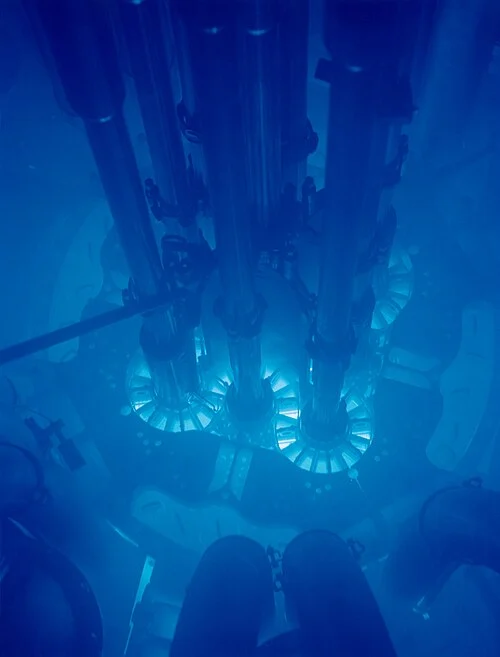
THIS is what Pavel Cherenkov saw glowing blue in his bottle of water in 1934. The gamma rays hitting the water were knocking electrons loose and accelerating them to speeds faster than light moves in water — and those electrons were painting a cone of blue light as they went, over and over, billions of times per second, until the whole bottle glowed.
The blue color is not a coincidence, and it’s worth pausing on.
Cherenkov radiation produces light across a range of frequencies, but the intensity increases toward shorter wavelengths — toward blue and ultraviolet. The physics behind this involves the way different frequencies of light interact with a medium, but the short version is: the higher the frequency, the more coherently the radiation adds up, and the stronger the glow. Blue and violet win. Which is why every photograph of Cherenkov radiation you’ve ever seen — reactor pools, particle detectors, medical imaging — has that same particular, eerie, unmistakeable color. Not purple, not white, not green. Blue. Always blue.
Pavel Cherenkov got a Nobel Prize in 1958. Twenty-four years after he stared at a glowing bottle of water and decided, for no good reason except good scientific instinct, that it was worth understanding.
Not bad, Pavel.
In Part 4, we find out what Brad Bradington is actually good for — from the cores of nuclear reactors to a cubic kilometer of ice at the South Pole.