
Two factors dominate our search for life and habitability elsewhere in the galaxy. The first is liquid water, which, as far as we know, is necessary for life. When we find exoplanets, scientists try to determine if they’re in their stars’ habitable zones. Under the right atmospheric conditions, liquid water could persist there.
The second is biosignatures. One of the reasons the JWST was built was to study exoplanet atmospheres and determine their contents, and it’s found some very interesting potential biosignatures. But scientists struggle with the fact that an atmospheric biosignature here on Earth could have a non-biological origin on exoplanets that are much different from Earth.
One of the ways forward is to develop an agnostic viewpoint. That’s the focus of new research in The Astrophysical Journal titled “An Agnostic Biosignature Based on Modeling Panspermia and Terraforming.” The authors are Harrison Smith from the Earth-Life Science Institute (ELSI) at Institute of Science Tokyo and Lana Sinapayen from the National Institute for Basic Biology in Okazaki City, Japan.
“Realistically, there are just a few locations to search for alien life within the solar system,” the authors write. “Outside the solar system, opportunities are nearly unlimited, but there’s a catch: it is difficult to attribute, with certainty, features of exoplanets to extraterrestrial life.”
The authors point out that individual biosignatures are susceptible to false positives, and that searching for technosignatures isn’t much better. They’re based on a whole host of underlying assumptions about the nature of a civilization’s technology and culture.
This work is focused not on individual exoplanets, biosignatures, and technosignatures, but on situations where life is spreading from world to world.
“We have developed an agnostic approach to exoplanet life detection that overcomes these limitations by using properties that emerge on the scale of groups of planets, without the need for a “smoking-gun” single-planet level biosignature,” the researchers write.
The researchers used models to show that if life is spreading from planet to planet or between star systems, that can affect “the observable properties of a planet.” That can create what they call a robust signature of life, with the added benefit that there would be very few false positives. It’s all based on statistical correlations between the locations of the planets and their characteristics.
“By clustering planets based only on their observed characteristics and retaining clusters localized in space, we demonstrate (and evaluate) a way to prioritize specific planets for further observation, based on their potential for containing life,” the authors explain.
This shifts the search from trying to find specific chemicals to a more pattern-based approach.
“By focusing on how life spreads and interacts with environments, we can search for it without needing a perfect definition or a single definitive signal,” Smith said in a press release. Sinapayen added, “Even if life elsewhere is fundamentally different from life on Earth, its large-scale effects, such as spreading and modifying planets, may still leave detectable traces. That’s what makes this approach compelling.”
This is all aimed at exoplanet surveys. When observing large numbers of planets, statistical trends can be identified in the data. Life could be identified not in individual cases, but by recognizing its effect over multiple planets. The idea is that as life spreads, it terraforms planets in particular ways that should be apparent in the data, whether that terraforming was intentional or not.
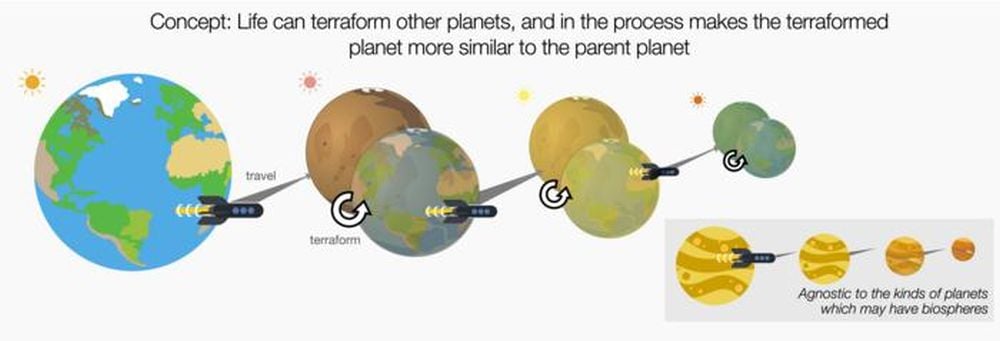 *If life spreads and reaches planets around other stars, it’s likely to terraform those planets, either intentionally or unintentionally. New research says we can find these worlds by searching through large exoplanet datasets for significant patterns, without having to detect any particular biosignatures. Image Credit: Harrison B. Smith*
“Going beyond (or below) a population-scale biosignature, we demonstrate how to select, from a population of planets, clusters that have a high likelihood of containing terraformed planets,” the researchers write.
Agnostic approaches like this are elegant because they sort of leap-frog over gaps in our knowledge. Some purported detections of potential biosignatures in planetary atmospheres have ended up being important lessons. They’ve shown us how different planets can be from one another and from Earth. They’ve shown us how abiotic processes on some worlds could produce what would be a biotic signature on ours. (Looking at you, phosphine.)
By looking for patterns across multiple planets that are extremely difficult to explain naturally, agnostic methods can overcome some of our own lack of knowledge. They can identify a trend before scientists can identify a specific molecule.
Of course it’s always important to note that this work is based on simulations. Simulations are powerful tools, and a critical part of the modern scientific effort. Supercomputer simulations are essentially vast numbers of thought experiments driven by methodically controlled inputs. But ultimately, only more observations and data can prove their effectiveness in any individual case.
One of the authors’ final paragraphs sums it up succintly:
“Our model results show promise that life could be detected at the scale of a population of planets, using information from only ≈1000 (perhaps fewer) planetary atmospheres, even in the absence of any information about what kinds of planetary environments are most suitable to life, or without knowing anything about the origins of life, or the peculiarities of life’s metabolic outputs,” they write.
This is basically pattern recognition, and pattern recognition is one of the human mind’s defining strengths. It makes sense that we’d take that gift, combine it with modern technology, and use the combination to search for life.