
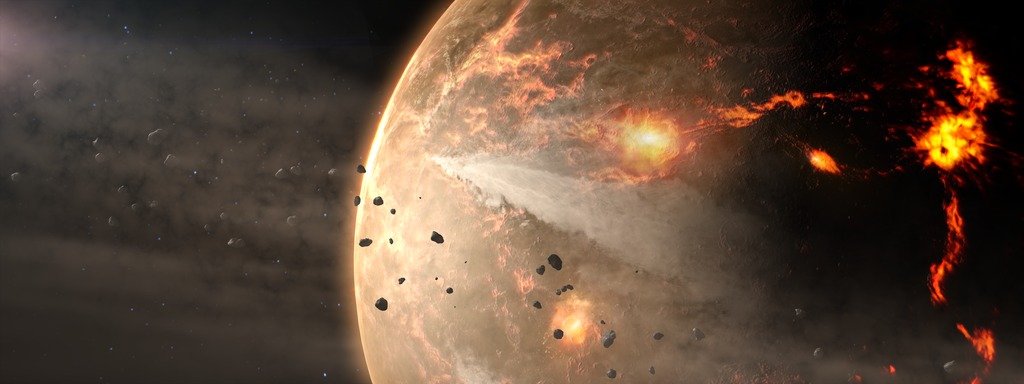
The simulations that captured the localized effects of individual large impacts also produced wholesale recycling of crust back into the mantle, with material dripping down to depths of at least 600 kilometers. Johnson thinks this recycling explains why so little Hadean crust survived to the present. It also explains, he argues, the near-total absence of shock-deformed Hadean zircons in the geological record. The researchers suggest that with so much melt present at shallow depths, it would have absorbed and scattered shock waves before they left lasting deformation in surviving crystals.
A turning point
The impact flux didn’t stay high forever; it declined more or less exponentially. Between 3.9 and 3.5 billion years ago, it had dropped enough that internal heat sources took over as the dominant influence on the crust. As impact heating faded, the upper mantle cooled, and the once-thin basaltic crust thickened.
The team’s modeling suggests crustal thickness reached around 30 kilometers by the early Archean, the era that came after the Hadean. This thicker, cooler, more rigid crust was also finally able to support plate tectonics, and it’s around this same time that the first continental rocks show up in the geological record. “As soon as you can create thick crust and you can create a mantle lithosphere underneath, you can start building continents,” Johnson said.
The team admits much of the argument rests on physics-based modeling rather than rock samples. In the absence of geological evidence, though, Johnson thinks reliance on modeling is justified. “We need to start taking seriously the outputs of these models rather than just say, well, we can’t find any rocks, so let’s give up,” he said. But ancient rocks, as hard to find as they are, may also pop up in near future—the Earth is extremely good at covering the tracks of its history, but it’s not perfect.
“In Nuvvuagittuq Greenstone Belt in Canada, a team of North American researchers has recently dated a dark, mafic rock as 4.2 billion years old,” Johnson said. “I also know another group has found a rock which is possibly even older. Hopefully you will be able to read about it in the next couple of months.”
Science, 2026. DOI: 10.1126/science.aeb5402