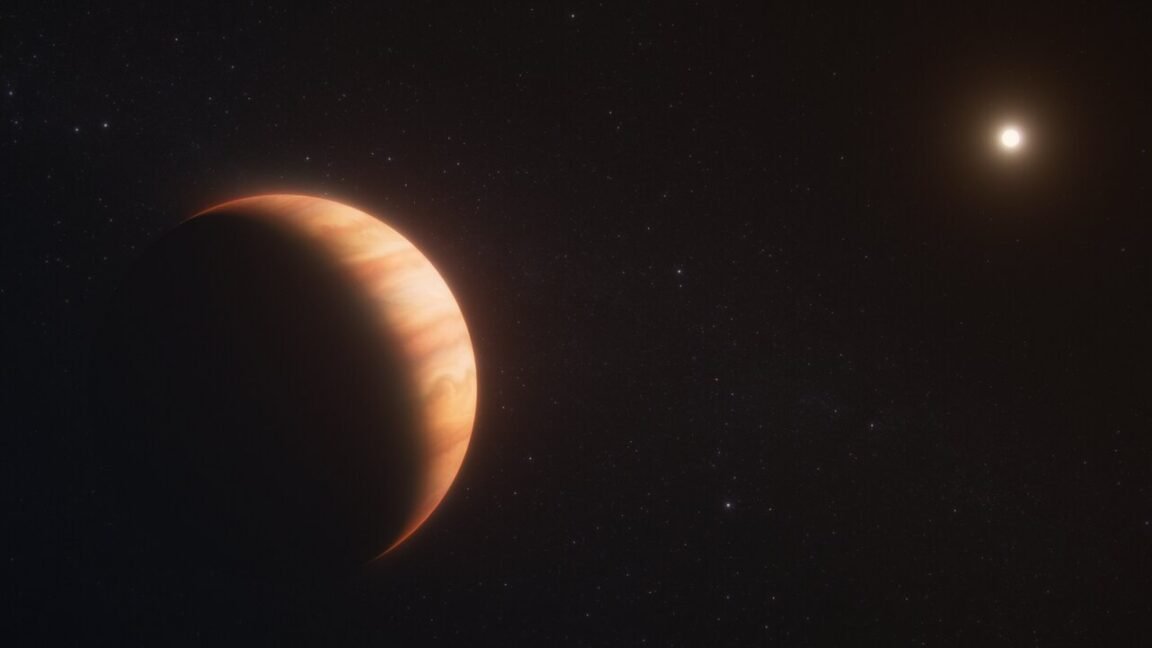
WD 1856 b is the only confirmed case of a planet that survived the death of a Sun-like star. It’s a Jupiter-size world orbiting a white dwarf—the burned-out remnant of a Sun-like star. Now, a team of astronomers has used the James Webb Space Telescope to take a closer look at this planet for the first time, and what they found makes an already strange system even stranger.
A feeding frenzy
WD 1856 b was an accidental discovery. Astronomers pointed the TESS observatory at a sample of roughly 2,000 white dwarfs in 2020. These stars are the remains of a Sun-like star that have already gone through a red-giant phase, leaving behind an Earth-size body that’s primarily composed of elements like carbon and oxygen. The TESS team was searching for small objects like comets or asteroids that might transit across the face of these dead stars.
What they found in the WD 1856 system was a gas giant. “As soon as they looked at it, they said, okay, that’s weird,” said Christopher O’Connor, a theoretical astrophysicist at Cornell University and co-author of the recent Nature study on WD 1856 b.
The white dwarf is about seven times smaller than the gas giant circling around it. Its brightness should be dropping to nearly nothing each time the planet crosses in front of it, but instead it’s dipping by about half. O’Connor thinks the reason is a grazing transit, where only the edge of the planetary disk clips the face of the star. “That’s a very unlikely viewing angle,” he said, “but it’s the only way to explain what we actually see.”
What’s more, the planet orbits at about 0.02 AU from the white dwarf, which goes against our ideas of how the death of a star should reshape its system. “When the star expands to become a red giant, it consumes the inner planets,” O’Connor explains. Then, in the process of shrinking down to a white dwarf, it loses about half of its original mass, which means its gravitational pull becomes weaker. “The outer planets, like gas giants, should migrate outward by about a factor of two,” O’Connor said.