
Lindsay Rasmussen sees the same potential. At Third Derivative, a climate-tech accelerator founded by the US nonprofit Rocky Mountain Institute, she works with startups such as Mimic Systems and Magnotherm on next-generation cooling. She stresses that solid-state cooling technologies are still in their early stages—promising, but unproven at scale. But “the space can move quickly if the right capital and partnerships are in place.”
The real question is not just whether these new technologies will work, but who will scale them and how quickly. History suggests the path won’t be linear, nor will it necessarily stay in Europe. Solar photovoltaics, for instance, began with research breakthroughs in Europe, moved into commercialization in the US, and ultimately scaled in Asia through vertically integrated supply chains. Solid-state cooling could follow a similar trajectory. As Rasmussen explains, innovations typically leave the lab and startups once they become commercially viable and are picked up by major manufacturers. Today’s cooling market is already dominated by multinational conglomerates such as Daikin and Samsung, which closely track emerging technologies and are ready to move quickly.
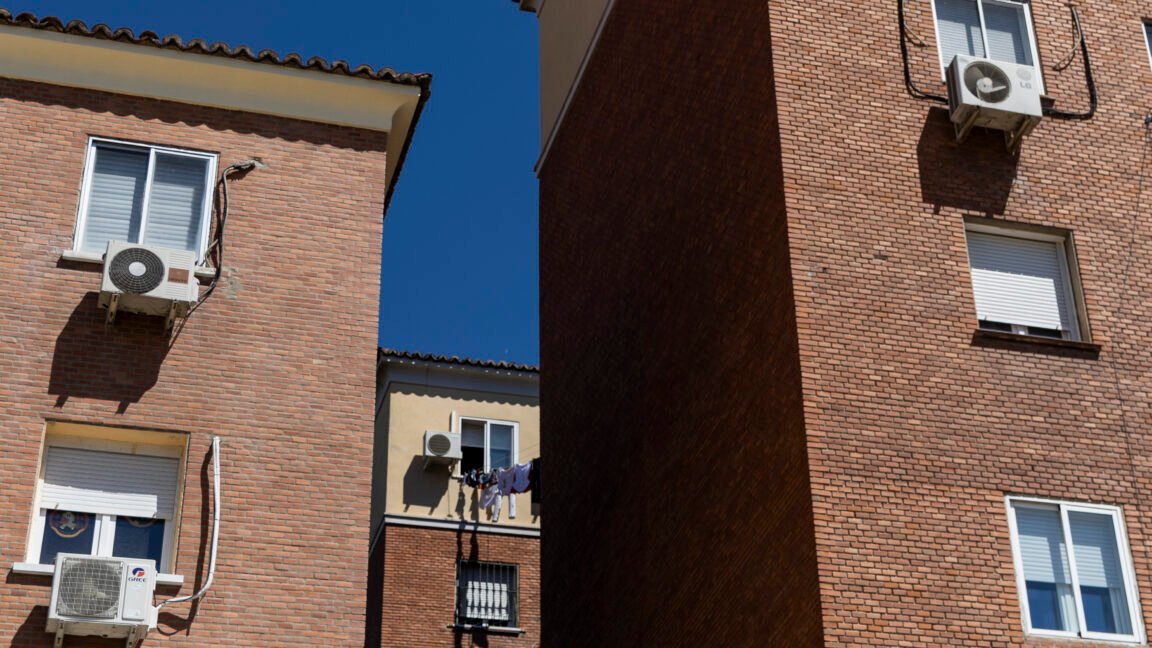
As the world rushes to cool itself, one reality risks getting lost: Installing more air conditioners will not, on its own, solve Europe’s overheating problem. Many of its cities trap heat in tightly packed buildings and concrete streets, and the challenge is how to cool them without compromising the aesthetics that make them so distinctive.
Both University of Oxford researcher Miranda and IEA analyst Voswinkel call for a “cooling hierarchy”: The priority should be preventing buildings from overheating in the first place—through trees, shade, reflective materials, and natural ventilation. Active cooling should come later, focused on the places that need it most, such as schools, hospital wards, and care homes. From Paris, where he is based, Voswinkel points to one efficient example: Ahead of the 2024 Summer Olympics, the city expanded its district heating network to also distribute chilled river water through underground pipelines, cooling public buildings. “I think that these heat waves are making more and more policymakers realize that we have to face this new reality and make good plans,” he says.
This story originally appeared at wired.com.